Latest
Essays · Notes on the research$24.9 billion of sponsor-backed debt comes due in 2027; $180.4 billion comes due in 2028. The buyer universe is shrinking. Multiple expansion is gone. Which makes the refinancing, not the exit, the first honest mark a portfolio company receives.
Read the essay →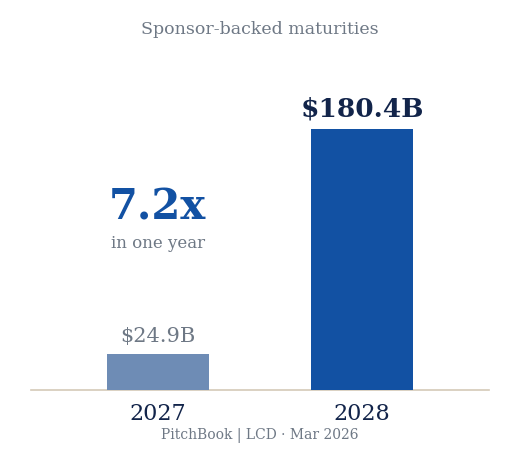
Exits fell nearly a third in the first half and 26.9% of US private equity inventory is already past seven years old. With dry powder halved, the default is to hold — and holding an aging asset has stopped being a portfolio judgment and become a decision someone will ask you to evidence.
Read the essay →Continuation vehicles are now the majority of the largest secondaries market on record. However a sponsor engineers liquidity, the asset still gets underwritten by a buyer who has no history with it and every reason to be skeptical — and portfolio company reporting was built for something else entirely.
Read the essay →Read the note
An amend-and-extend is the sensible move when the alternative is refinancing into a rate you cannot carry. At 6.7%, plenty of 2021-vintage borrowers are looking at a coupon well above what they underwrote, and pushing the maturity out two years for a fee and a modest spread bump is straightforwardly cheaper than the alternative. Nobody should apologize for doing one.
What is worth being precise about is what the transaction did and did not accomplish.
It bought time. It did not change the business’s capacity to service debt, and it did not improve the terms on which the eventual refinancing happens. In most cases it made those terms slightly worse — the amendment fee is real, the spread usually steps up, and the extended maturity now sits closer to a wall that other borrowers are extending into at the same time.
The operating question that follows is the one I would want answered in the board meeting after the amendment closes, not eighteen months later: what specifically has to be true about this business by the new maturity date for the refinancing to be routine? Not survivable — routine. Usually the answer is a number: EBITDA at some level, leverage below some multiple. That number belongs on the operating plan the week the amendment signs, and someone should own it.
The risk in a successful A&E is that it feels like a resolution. The lender said yes, the pressure came off, and the finance team goes back to closing the month. Two years pass at the pace two years pass, and the same conversation reopens with less room and a shorter runway.
The version of this that works treats the extension as what it is — a purchased option with an expiry date — and works backward from that date from the first week.
Read the note
No add-on, no recapitalization, no refinancing, no dividend recap. Four years without touching the capital structure gets read two ways, and the difference matters enormously to the CFO sitting inside one of these companies.
The benign reading is that the business is fine and the sponsor sees no reason to transact. The other reading is that the option to transact quietly closed — that a lender conversation started, went badly, and never restarted, and nobody wrote that down anywhere a board would see it.
What I would want to know, from the operating seat: when was the last time anyone actually tested the market? Not modeled a refinancing — tested it. A company that has not had a real conversation with a lender since 2021 is holding a set of assumptions about its own credit that were formed in a different rate environment, and the first time those assumptions get examined should not be the week a maturity comes due.
Read the note
Maintenance covenants were never primarily a lender protection. They were a scheduled conversation — a quarterly forcing function that made someone look at the trajectory and say it out loud while there was still room to act.
Remove them and a deteriorating borrower can service debt and avoid technical default more or less indefinitely. That sounds like relief, and in the short run it is. What it actually does is push discovery from quarter four of year one to the refinancing, by which point the options that were available early — a cost program with time to work, an add-on that changes the growth story, an orderly conversation with the existing lender — have narrowed to the ones that get taken under pressure.
The practical consequence for a portfolio company: nobody is going to force you to look. If the finance function is not producing covenant headroom analysis against a realistic downside case on its own initiative, that analysis is not happening. It was never the lender’s job to run it — the covenant just made sure someone did.
The credit decision is rarely made on the numbers in the deck. It is made on four questions the deck cannot answer — and on whether the person answering them sounds like they run the business or like they are reading about it.
Read the essay →Read the note
That is the whole story of the last decade in two numbers. A third of the return used to arrive because the market repriced the asset while you owned it. Now essentially none of it does, and the entire burden has shifted to revenue growth and margin expansion — which is to say, to operations.
The uncomfortable implication is not that value creation plans need to be better. It is that they now need to be measured properly, because there is no longer a valuation tailwind to cover an initiative that did not work. When multiple expansion was doing a third of the lifting, a mediocre cost program was survivable. It is not survivable now, and the only way to know whether a program is working in month four rather than month fourteen is a finance function that can actually attribute results to initiatives.
That is a reporting problem before it is a strategy problem, and it is usually the last thing staffed.
It is the workstream that gates every other one — and it is almost always scheduled last. The cost is not accuracy. It is velocity: a sponsor who does not fully trust the reporting cannot move at the speed the plan assumes.
Read the essay →Stratis Group works with private equity sponsors and portfolio company management teams on financings and finance operations — as a finance operating partner rather than an external advisor.
jon@stratisgroupllc.com