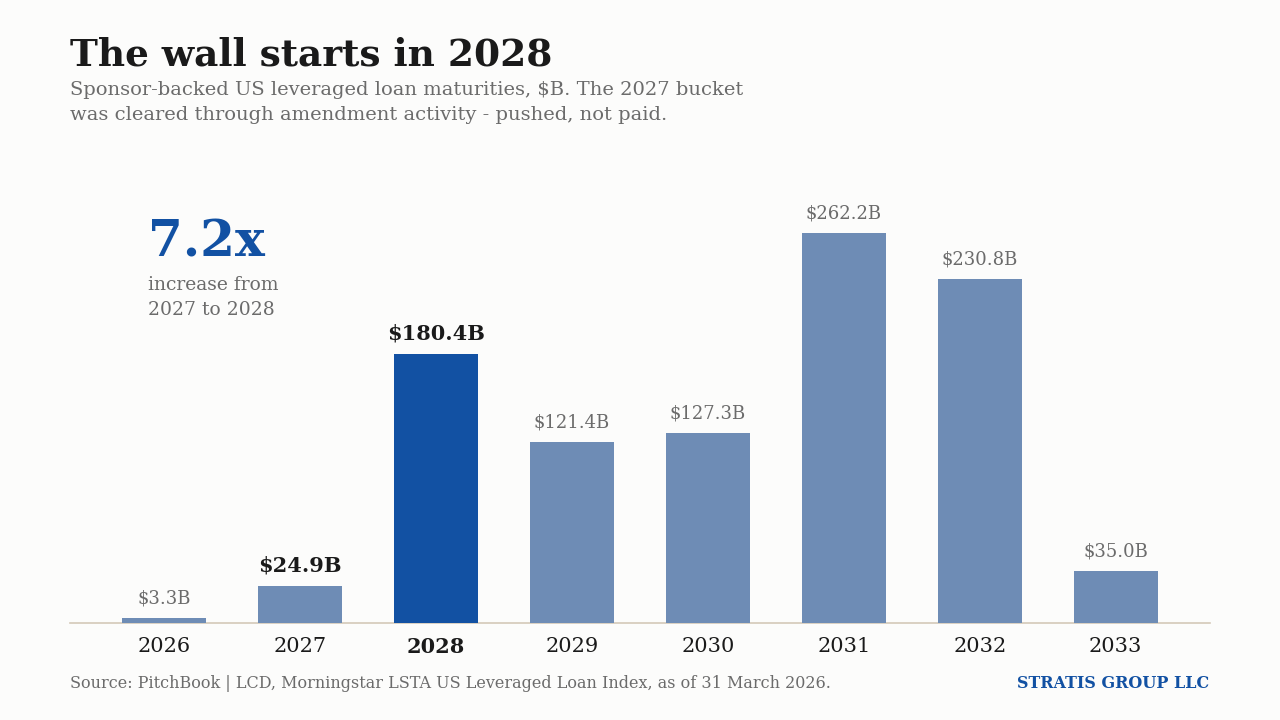
That is not growth. It is a step function, and it is the shape of a problem that has been moved rather than solved. The 2027 bucket was cleared through amendment activity — pushed, not paid. Amend-and-extend volume has more than doubled since 2021. The debt did not go away; it was relocated to a year that is now close enough to plan for.
The obvious response is that 2028 can be relocated too. Sometimes it can. But the mechanism that made a maturity a non-event in the first place has stopped working, and it is worth being precise about what broke.
The question this ends on — who actually runs a portfolio company refinancing — is where a firm like Stratis Group LLC gets hired. I come back to it at the end.
The exit used to pay off the debt
The old sequence resolved itself without anyone thinking hard about it. Buy the company, hold it four or five years, sell it, and the sale retires the debt. A refinancing along the way was housekeeping — a better rate, a larger revolver, a dividend recap on the way through. Nobody underwrote the business from scratch, because everybody knew an exit was coming.
That sequence assumed a buyer. PitchBook's Q2 2026 Global Private Market Fundraising Report, published 3 September, contains the arithmetic on that assumption, and page nine is where it sits.
The headline reads as recovery: $165.3 billion in second-quarter closings, lifting the rolling twelve-month total to $468.8 billion from $417 billion in the first quarter. Underneath it, three numbers matter more.
Concentration. Since 2024, 77% of capital raised has flowed to funds over $1 billion, against 63.6% in the 2014 through 2016 period. PitchBook's characterization of the consequence is blunt: the middle market is struggling to elbow its way into new allocations, even if it is winning on performance.
First-time funds. Thirty-six closed in the first half of 2026, totalling $7.7 billion. In 2023 the figures were 299 funds and $41.4 billion; in 2024, 236 and $28.2 billion; in 2025, 123 and $21.3 billion. That channel has not slowed. It has closed. PitchBook draws the conclusion directly — for an industry needing to clear its inventory backlog, this is a worrying sign that the list of likely buyers is shrinking.
Where the new money goes. US evergreen private equity AUM nearly doubled from $51.3 billion at the end of 2024 to $99.3 billion by the first quarter of 2026. In dollar terms that more than replaces the missing first-time funds. In buyer terms it replaces nothing, because it funnels into the largest general partners with established wealth products — not the firms that acquire a $40 million EBITDA business in the Southeast.
The capital didn't disappear. It moved — into vehicles that don't buy middle-market companies.
Set that against the inventory. There are 13,509 private-equity-backed companies in US sponsor portfolios. Of those, 4,568 have been held more than five years and 2,536 are at or beyond the traditional exit window. General partners are sitting on more than $860 billion in buyout NAV across funds more than seven years old.
Fewer buyers, more inventory, longer holds. That is subtraction, not a forecast. And when the hold stretches past the maturity, the refinancing is no longer bridging the company to a sale. It is carrying the company to an exit that has not arrived and may be years out.
The escape hatch closed
There was one more mechanism that used to resolve this quietly, and its disappearance is the whole argument.
StepStone's value-creation data splits enterprise value creation into three drivers: revenue growth, EBITDA margin expansion, and multiple expansion. For deals entered between 2011 and 2013, multiple expansion accounted for 37.3% of value created. For 2014 to 2016, 21.2%. For 2017 to 2019, 10.6%.
For the 2020 to 2022 entry cohort: 0.5%.
The market is no longer contributing anything to the outcome. Whatever value exists has to come from the business — revenue and margin. A sponsor who bought at 12x and has not grown EBITDA faces a market pricing the asset closer to 10x, and after the debt is repaid there may be no equity left at all.
That is why the refinancing has stopped being administrative. When the market added three turns on the way out, a slightly optimistic model was harmless; the exit covered it. With the market adding nothing, what the business can actually support becomes the entire question — and the lender is the first party to ask it seriously.
A credit committee pricing a 2028 maturity in 2026 runs the diligence a buyer would run. It tests the model rather than admiring it. It examines the quality of earnings. It asks what covenant EBITDA looks like next to cash EBITDA. Same questions a buyer asks, earlier in the timeline, and with considerably more leverage over the answer — because the alternative to agreement is a maturity default.
The refinancing is now the first honest mark the asset receives. Not the quarterly valuation. Not a broker's indication. A committee with its own capital, pricing the business on what it can prove.
Which is also why the timing is nearer than the date suggests. Lenders want twelve to eighteen months of runway to refinance properly. Inside twelve months the facility goes current on the balance sheet, the auditors arrive with it, and the negotiating position collapses because the counterparty can see the clock. A 2028 maturity is worked in late 2026 and early 2027. That is now.
Two different problems, two different playbooks
Before going to market, there is a diagnosis to make, and it determines everything after it.
The first is a sponsor-return problem. Enterprise value still covers, or nearly covers, the debt stack. Lenders are whole. The outcome is a diminished return, a partial loss, or no return — painful, but the capital structure is intact, the financing is a financing, and run properly it buys runway to fix the operating story and exit at a real price.
The second is a capital structure problem. Enterprise value has eroded to where a sale leaves lenders short, yet the company still generates enough cash to service its debt and avoid a technical default. Nobody has an incentive to force the issue. The sponsor holds because selling crystallizes a loss. The lender extends because a non-accrual damages reported yield. The amend-and-extend becomes a recurring feature of portfolio management rather than a bridge to anything, and each round narrows the universe of eventual buyers.
Different work, different counterparties, different conversations. A sponsor who runs the second as though it were the first arrives at market, gets repriced by a lender who has done the diagnosis the sponsor skipped, and loses both the terms and the initiative.
A note on how this gets discussed. The widely quoted figure that 92% of outstanding leveraged loans are covenant-lite is accurate — for the broadly syndicated market. It does not describe a middle-market company financed by two direct lenders, where a maintenance covenant is still standard. The middle-market covenant has not disappeared; it has been hollowed out, with wider cushions, generous EBITDA add-backs, springing tests and automatic resets. Similar effect, different mechanism — and the mechanism determines who can force a conversation and when. The gap between covenant EBITDA and cash EBITDA is the real slack in every leverage figure quoted in a lender meeting, and it is the first thing a serious credit committee will find.
The capital is there. The case is what's missing.
None of this describes a market without money in it.
Private debt was the only strategy with trailing twelve-month fundraising up — 14% year over year, with first-half 2026 fundraising up 27.3%. Dry powder fell by more than $120 billion to $547 billion at the end of 2025, a decline that reflects managers deploying capital they had already raised rather than retreating from the asset class.
Lenders have capital and they are putting it to work. Availability is not the constraint. The constraint is presenting a case that survives a credit committee that knows perfectly well the sponsor's alternatives are limited.
That case is a specific deliverable. A model built to be tested rather than admired. A quality-of-earnings position that holds up under examination. An honest read of what the business supports, arrived at before the lender arrives at his own. And enough competitive tension in the process that terms are negotiated rather than accepted.
Which raises the question of who runs it
The portfolio company CFO is built for month-end close, lender reporting and the board package, and is usually good at all three. Running a financing against a credit committee is a different job, and doing it properly means not doing the first one for four months — at a company that cannot afford to have its finance function looking the other way.
The placement agent is priced off the transaction and, more to the point, does not know the business at the depth the diligence now requires. Operating partners have watched lenders notice.
So it lands on the deal partner. The most expensive person in the building, whose actual job is sourcing, spending a quarter defending someone else's projections.
That vacancy is the whole problem, and it is not a staffing inconvenience. It is why refinancings that should have been won on preparation get settled on whatever the lender proposes.
The exit market will reopen. Most of the inventory will clear, slowly, at prices below what was underwritten. In the meantime the debt comes due on a schedule that has nothing to do with when a buyer shows up.
Your maturity date is the appointment you actually have. Better to keep it on a prepared case than on a lender's.
This is the gap Stratis Group works in. We represent the company and the sponsor through a portfolio company capital raise — a refinancing, a covenant reset, an acquisition financing, or the preparation that precedes a recapitalization. The sitting CFO keeps running the business. Stratis absorbs the process.
- 1 · Diagnostic 2–3 weeks
Inside the operations and the numbers with your finance team. What the business can actually support, where the story is thin, what a credit committee will test. - 2 · Package 3–4 weeks
The model, the materials, the data room. Built to the standard a lender reads, not a deck. - 3 · Market 6–10 weeks
Outreach to the right debt or equity partners. Interviews and vetting run by Stratis; only real interest and genuine fit advance. - 4 · Close 4–8 weeks
Management in for the meetings that count. Terms negotiated, diligence carried, through to funding.
Fifteen to twenty-five weeks — which is the other reason a 2028 maturity is a 2026 conversation. If a portfolio company in your book has a maturity inside the next twenty-four months, send me the year and the approximate size and I will tell you which of the two problems it looks like.
jon@stratisgroupllc.com