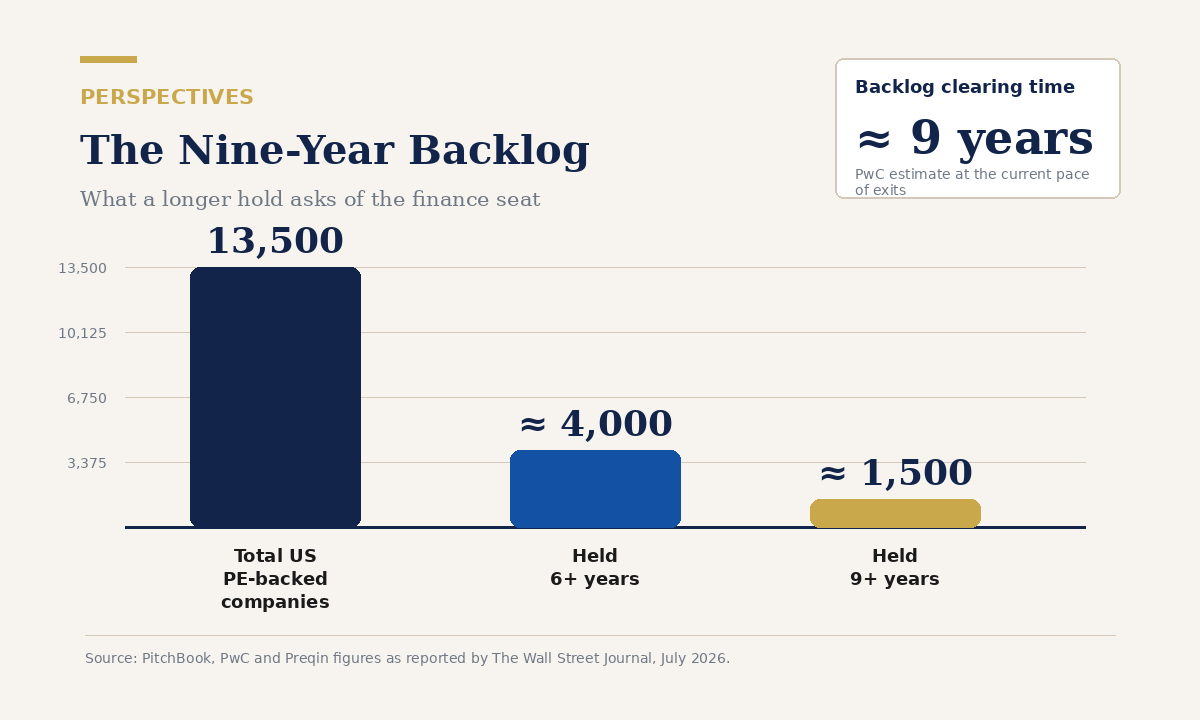
Private equity has a timing problem. About 13,500 U.S. companies sat in private equity portfolios at the end of June, according to PitchBook data reported by The Wall Street Journal. Almost 4,000 have been held for six years or more, and roughly 1,500 for nine years or more. At the current pace of exits, a PwC analysis estimates it would take about nine years to clear the backlog.
Software sits at the center of it. Only about 1,200 of those companies are software businesses, but they tie up an outsized share of capital, much of it deployed at 2020 and 2021 valuations and financed on the assumption that pandemic-era growth would continue. This year’s reset in public software multiples, driven by concerns over what AI means for the category, has widened the gap between what sponsors paid and what buyers will pay. As one advisor put it to the Journal, “The 2021 assets are probably the hardest ones to exit right now.”
Sponsors are adapting. Continuation vehicles and the secondary market are giving limited partners a way to cash out while the sponsor keeps the asset. Recapitalizations are buying time. And the IPO window is reopening, with 16 private equity-backed listings in the first half of the year, the most in a six-month period since 2021, according to Preqin.
A longer hold is a different job
A company bought on a three-to-five-year plan and now heading into year seven or eight is not the same company with more time. The assumptions underneath it have changed: the debt was sized for faster growth, the covenants were set for a different trajectory, and the finance team was built to support a sale that hasn’t happened. Meanwhile, every exit route still open, whether a continuation vehicle, a recap, a strategic sale or an IPO, brings its own round of diligence.
That puts the finance function under pressure from several directions at once:
- A capital structure that no longer fits the timeline. Maturities arrive before the exit does. Refinancing, amend-and-extend conversations and covenant resets become central to the value creation plan, not side issues.
- Diligence that never really ends. Continuation vehicle buyers, recap investors and strategic acquirers all want clean, defensible numbers: quality of earnings, working capital, cohort retention, the bridge from bookings to cash.
- The AI question, answered in numbers. Buyers are asking whether a software company’s position is durable. The answer has to show up in net revenue retention, gross margin, sales efficiency and product investment, not just in a narrative.
- Cash discipline for a longer runway. A 13-week cash forecast, tighter working capital and a clear view of liquidity matter more when the exit date keeps moving.
- Leadership continuity. Long holds often outlast the CFO who started them. When that seat turns over in year six, the company can’t afford a gap in front of lenders, the board or a buyer.
Where Stratis Group helps
Stratis Group works with sponsors and their portfolio companies at exactly these points. After three CFO roles with PE- and VC-backed companies, I bring the operating finance experience a longer hold demands:
- Debt and equity raises, CFO-led on retainer. Refinancing, covenant resets, add-on financing and recaps, run from the CFO seat rather than handed off. I have closed a $60M+ syndicated credit facility and raised $30.5M of growth equity.
- Exit and continuation readiness. Building the diligence package before the buyer asks: quality of earnings preparation, a credible model, clean multi-entity reporting and the retention and margin story software buyers now demand.
- Retained advisory for sponsors. A finance operator on call across the portfolio to diagnose value creation plans, assess the CFO bench and sharpen the narrative ahead of an exit.
- Interim and fractional CFO. Continuity in the seat when the hold outlasts the original team, or capacity when the company needs senior leadership without a full-time hire.
The backlog won’t clear itself. Sponsors who use the extra time to strengthen the capital structure, the numbers and the finance team will be the ones ready when the right exit appears, whether that is a continuation vehicle next year or an IPO when the window opens wider.
If you are working through a longer hold, I would welcome the conversation. jon@stratisgroupllc.com
Source: Mark Maurer, “Private-Equity Firms Are Sitting on a Nine-Year Backlog,” The Wall Street Journal, July 7, 2026. Figures cited from PitchBook, PwC and Preqin as reported.